Ratu Boko the lost Masterpiece Palace Complex from the 8th century, the only Hindu and Buddhist Mixed-architectural Archeological site
The history of Ratu Boko, begin with Prambanan
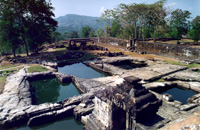
The original architectural layout and design is not fully known, within the 19.6 Ha of land on top of the hill, there remain the stone basements of pendopo hall (on which stood wooden building) and other palace building, a structure that was presumably a water tank or a bathing place man-made flat terrace and ruins of stone walls.
The history of Ratu Boko, begin with Prambanan are a large number of inscription dating from the second half of the eight century to the middle of ninth century have been found on Ratu Boko hill and at the Kalasan, Loro Jonggrang, Sewu, Plaosan and other candi. In particular, the Sanskrit inscription dated in 856 AD is important. From them it can be summarized that the Buddhist Shailendra dynasty and the Hindu Mataram often cooperated with one another but that in the middle of the ninth century the later defeated the former.
When we heard the word Kraton (Palace), our imagination will automatically think about Rakai, Palace and the Royal facilities. But those that we imagine can't be found at Ratu Boko Kraton, when it was found, and who gave the name. According to the ancient inscription that was made by Rakai Panangkaran in 746-784 AD, at the beginning the building around Ratu Boko heritage site is called Abhayagiri Wihara. Abhaya means no danger or peace.
Abhayagiri means the Buddhist monks dormitory/wihara that is located at the peaceful area on top of the hill. In the next period between 856-863 AD, Abhayagiri Wihara changed its name became Walaing Kraton that is proclaimed by Vasal Rakai named Rakai Walaing Pu Kumbayoni. Mandyasih inscription, which was built in 898-908 AD by Rakai Watukara Dyah Balitung, still mentioned Walaing as the pedigree of Punta Tarka who made Mantyasih inscription. From the beginning of 10th century until the end of 16th century, there is no news about Kraton Walaing.
The Shailendra stronghold at that time was Ratu Boko hill, and three kinds of “lingga” were erected to commemorate the Mataram victory. Prior to that, “candi Siwa” probably meaning candi Loro Jonggrang, was built.
Much still unknown, but more and more of the history of that time will no doubt come to light in time with the discovery of more such inscription if they are carefully preserved.
For those who love, within the mind’s eye to reconstruct history, Ratu Boko is a dream.
The main site is on a small plateau. The trek is best done at dawn or in the late afternoon when the views from the plateau’s ridge are most beautiful. Ratu Boko was probably a fortified palace built by the Buddhist Sailendra and later taken over y Hindu Mataram.
Little remains apart from a huge, sparsely ornamented gateway and a series of foundations and bathing places, but the atmosphere are enchanting. A few hundred meters to the south on another small plateau (linked with the first, but difficult to find) is a large stone platform with decorated waterspouts and staircases surrounded by an empty moat; a little below the platform, through kala-head gateway, is a group of tranquil green pools, one of which is still used by the villages.
According to HJ. DeGraff, in 17th century there were many European travelers who came to Indonesia. Those travelers said that there was also a heritage site which mentioned about Prabu Boko who came from Bali. Ninety years later, in 1790. Van Boeckholtz found the heritage ruin above Ratu Boko heritage sites.
The Publishing of this founding attracted scientists like Makenzic, Junghun and Brumun who came to visit and made recording about the heritage site at Ratu Boko Hill in 1814. One hundred years later, FDK Bosch made a research and reported it which entitled "Kraton Van Ratoe Boko". According to FDK Bosch, the site at Ratu Boko Hill is known as Kraton Ratu Boko.
People who live around Ratu Boko Hill usually call it as Dawun, temple just like the name of their village. That is why in some literatures and old maps, Ratu Boko Hill is written in 2 (two) name: Dawung Temple and Kraton Ratu Boko van Ratoe Boko.
The name of Kraton Ratu Boko comes from the word Kraton van, Ratu Boko. Kraton is from Ka-da-tu-an that means King's or Rakai’s Place. Ratu Boko comes from the word Ratu which has the meaning as King and Boko is heron. This understanding comes up with question whether the King of Heron is the ruler himself or the real bird. Therefore, people say that Ratu Boko keeps a mystery up to now.